
Excavation Services for Commercial Projects Explained

Commercial Excavation: Site Preparation, Grading & Utilities
Commercial excavation is the engineered removal and relocation of earth to get large sites ready for commercial buildings, infrastructure, and site development. Done correctly, excavation establishes stable foundations, sets proper drainage and utility locations, and achieves the tolerances pavement and structures require. This guide outlines what commercial excavation covers, how it differs from residential work, and the typical stages from initial evaluation through final grading and project handoff. You’ll get practical guidance on land clearing and soil testing, grading and erosion control, underground utility installation and testing, and why professional foundation excavation prevents costly structural failures. We also cover road and parking-lot preparation and offer a buyer’s checklist for selecting a qualified commercial excavation contractor. Technical terms like mass grading, utility trenching, bedding, and compaction are integrated with real-world examples to help owners, engineers, and project managers make confident decisions.
What Is Commercial Excavation and How Does It Differ from Residential Excavation?
Commercial excavation focuses on large-scale sites—retail centers, office parks, industrial campuses, and multi-building developments—where earthmoving, utility corridors, and engineered fills must meet tight design tolerances. Compared with residential work, commercial projects involve deeper cuts, larger mass grading operations, more complex drainage and utility networks, and stricter permitting and inspection requirements. The scale and performance expectations call for heavier equipment, comprehensive QA/QC testing, and coordination with civil engineers and utility authorities. Recognizing these differences helps owners specify the right contractor, sequence work correctly, and control material handling and compaction from the start. The next section defines common commercial services and project types to ground those differences in practical examples.
Defining Commercial Excavation Services and Their Scope
Commercial excavation services include site preparation, mass and fine grading, drainage and stormwater work, utility trenching and installation, foundation excavation, road base construction, and site restoration. These capabilities are organized to support development phases for shopping centers, office parks, distribution yards, and municipal infrastructure. Typical deliverables are cleared sites, engineered subgrades, utility corridors with bedding and compaction documentation, shored foundation excavations, and paved bases built to civil specifications. Local contractors in Jacksonville, FL, commonly bundle these services; Arc Excavation, for example, lists site preparation and utility installation among its core offerings in Central Florida. That breadth of service sets the stage for a closer look at project stages, from evaluation to final grading.
Key Differences Between Commercial and Residential Excavation Projects
- Scale and Complexity: Commercial sites need mass earthwork and phased coordination across larger footprints and multiple trades.
- Permits and Inspections: Commercial work often requires complex permitting, stormwater approvals, and frequent third‑party inspections.
- Equipment and Materials Handling: Heavy equipment and larger material volumes require specialized logistics, trucking, and disposal plans.
- Design Tolerances and QA/QC: Commercial pavements and foundations demand tighter compaction tolerances and documented testing for structural performance.
These contrasts affect cost, schedule, and risk allocation. Identifying them early helps teams write the right scope, secure proper engineering controls, and reduce rework. The following section walks through the sequential stages that turn a raw parcel into a build‑ready commercial site.
What Are the Essential Stages of Commercial Excavation Projects?
Commercial excavation projects move through a sequence of stages that turn planning documents into a construction-ready site, balancing earthwork, utilities, and environmental controls. Each stage produces measurable outcomes—from survey maps and soil reports to compacted subgrades and verified utility trenches—so owners and contractors can track progress against milestones. Below is a clear, numbered process showing the typical flow and responsibilities during site development. After that list, a compact table summarizes expected tasks and deliverables for each stage.
- Site evaluation and survey: establish boundaries, locate existing utilities, and complete geotechnical testing to inform earthwork design.
- Site preparation and clearing: remove vegetation, demolish structures, and stage material handling and disposal to create a safe work area.
- Mass grading and earthwork: perform bulk cuts and fills to achieve design elevations and prepare for fine grading.
- Utility trenching and installation: coordinate locates, trench to specified depths, bed and install utilities, then backfill and compact.
- Foundation excavation and support: excavate footings or deep pits with appropriate shoring, dewatering, and QA checks.
- Final grading, paving base, and handoff: complete fine grading, subgrade compaction, and base construction prior to paving or landscaping.
This staged approach creates clear contractual scopes and reduces rework caused by poor sequencing or uncoordinated trades. The table below contrasts stages with their primary tasks and expected deliverables.
This table clarifies stage responsibilities and outputs for planning and specification purposes.
| Stage | Typical Tasks | Outcome / Deliverable |
|---|---|---|
| Site Evaluation | Topographic survey, utility locates, geotechnical borings | Survey maps, soil reports, risk notes |
| Site Preparation | Clearing, demolition, erosion-control setup | Cleared site, erosion controls, permit logs |
| Grading & Earthwork | Mass cuts/fills, compaction, rough grading | Engineered subgrades, compaction reports |
Next, the section on site preparation reviews the core activities and testing that reduce subsurface risk before heavy earthmoving begins.
Site Preparation: Land Clearing, Demolition, and Soil Testing
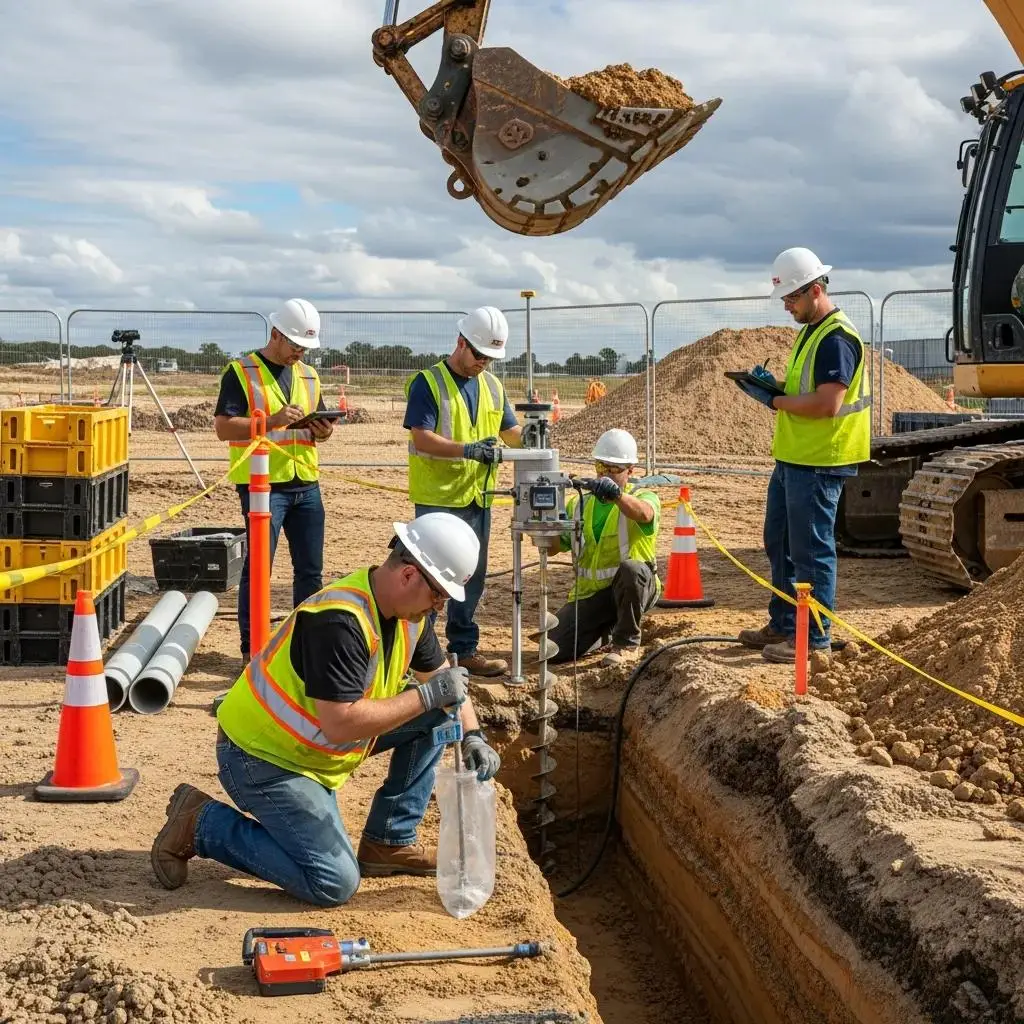
Site preparation is the first risk‑reduction phase: remove obstacles, assess contamination potential, and establish erosion and dust controls. Land clearing uses mulching, mechanical removal, or selective demolition depending on permits and environmental constraints; debris is classified for disposal or recycling under regulatory guidance. Geotechnical testing—borings, standard penetration tests, and lab classification—identifies bearing capacity, moisture conditions, and reactive soils that determine foundation and compaction requirements. Utility locates and permit coordination protect crews and prevent costly service strikes, while sediment-and-erosion controls protect downstream systems during construction. In Jacksonville, many contractors bundle clearing and geotechnical coordination in a site‑prep package to streamline approvals and mobilization. Understanding these elements informs the grading strategy that follows.
Grading and Earthwork: Mass Grading, Fine Grading, and Erosion Control
Grading unfolds in two main phases: mass grading to establish bulk elevations and cut/fill balance, and fine grading to create precise subgrades for foundations and pavement. Mass grading optimizes earthmoving volumes—reducing hauling—using dozers and scrapers guided by survey stakes and GPS control. Fine grading hits tight tolerances for structural pads and pavements; compaction specs and proof‑rolling verify subgrade performance for design loads. Erosion controls—silt fences, sediment basins, stabilized entrances, and temporary seeding—protect watercourses and meet regulatory requirements. Compaction testing, typically with a nuclear gauge and lab correlation, creates the QA/QC record required for municipal acceptance and paving readiness. With grading complete, the project moves into underground utility installation, which must be coordinated to protect the finished subgrade.
How Are Underground Utilities Installed in Commercial Excavation?
Installing underground utilities on commercial sites is a coordinated workflow of planning, trenching, installation, backfill, compaction, and commissioning to ensure long‑term reliability and compliance. It starts with utility coordination and locates to reveal existing infrastructure and conflicts. Trenching follows to designed depths, with proper bedding materials and separation distances for different utilities. After installation, staged backfill and compaction restore structural capacity and protect adjacent subgrades. Final testing—pressure tests, CCTV for sewers, and continuity tests for conduits—confirms performance before surface restoration. This sequence minimizes future service interruptions and preserves pavement and foundation integrity. The sections below cover storm drainage first, then sewer, water, and communications installations.
Storm Drainage Systems and Their Importance in Commercial Sites
Storm drainage systems manage runoff to protect foundations, pavements, and downstream infrastructure. Commercial sites typically combine conveyance elements (gutters, inlets, pipes) with detention or retention solutions to meet peak‑flow controls. Design factors include watershed imperviousness, runoff coefficients, and allowed release rates; components may include grates, manholes, catch basins, and storm piping sized for design storms. Common materials are reinforced concrete pipe, HDPE, and precast structures; installation requires accurate invert elevations, correct bedding, and outlet protection. Maintenance and access—cleanouts, forebays, and sediment traps—are specified to prolong performance. Regulatory inspections often require as‑built elevations and a post‑installation maintenance plan, both of which affect pavement and landscape sequencing on site. drainage solutions.
Installation of Sewer, Water Lines, and Communication Conduits
Sewer, water, and communication conduit installations follow specific trench depths, bedding details, and testing regimes to ensure durability and serviceability. Sewers need minimum slope, proper diameters, and inlet protection; tests include infiltration/exfiltration or low‑pressure air tests and CCTV inspection before acceptance. Water mains require corrosion protection, thrust blocks at fittings, hydrant placement, and pressure/chlorination testing prior to commissioning. Communication conduits need continuous runs, separation from power and water, and pull‑box locations for future cabling. Backfill is typically controlled select material with mechanical compaction over pipes to prevent settlement. Arc Excavation lists underground utility installation and drainage solutions among its commercial services, reflecting the bundled capabilities contractors provide while meeting inspection and safety requirements. Proper utility work sets the stage for foundation excavation and final surface restoration.
Why Is Professional Commercial Foundation Excavation Crucial for Construction?
Foundation excavation is a technical activity that directly affects structural performance—mistakes in depth, tolerance, shoring, or dewatering can cause differential settlement, rejected concrete, or unsafe excavation faces. Proper foundation work requires geotechnical coordination to locate competent bearing strata, shoring systems when cuts exceed stable slopes, and groundwater control through pumps or wellpoints as needed. Tight excavation tolerances ensure footings and pile caps interface correctly with formwork and reinforcement; documented subgrade compaction and inspection checkpoints reduce disputes later. These controls lower project risk, limit change orders, and ensure structural loads transfer to competent soils as designed. The sections below describe deep‑excavation techniques and why accurate footing excavation matters for long‑term stability.
Deep Foundation Excavation Techniques for Commercial Buildings
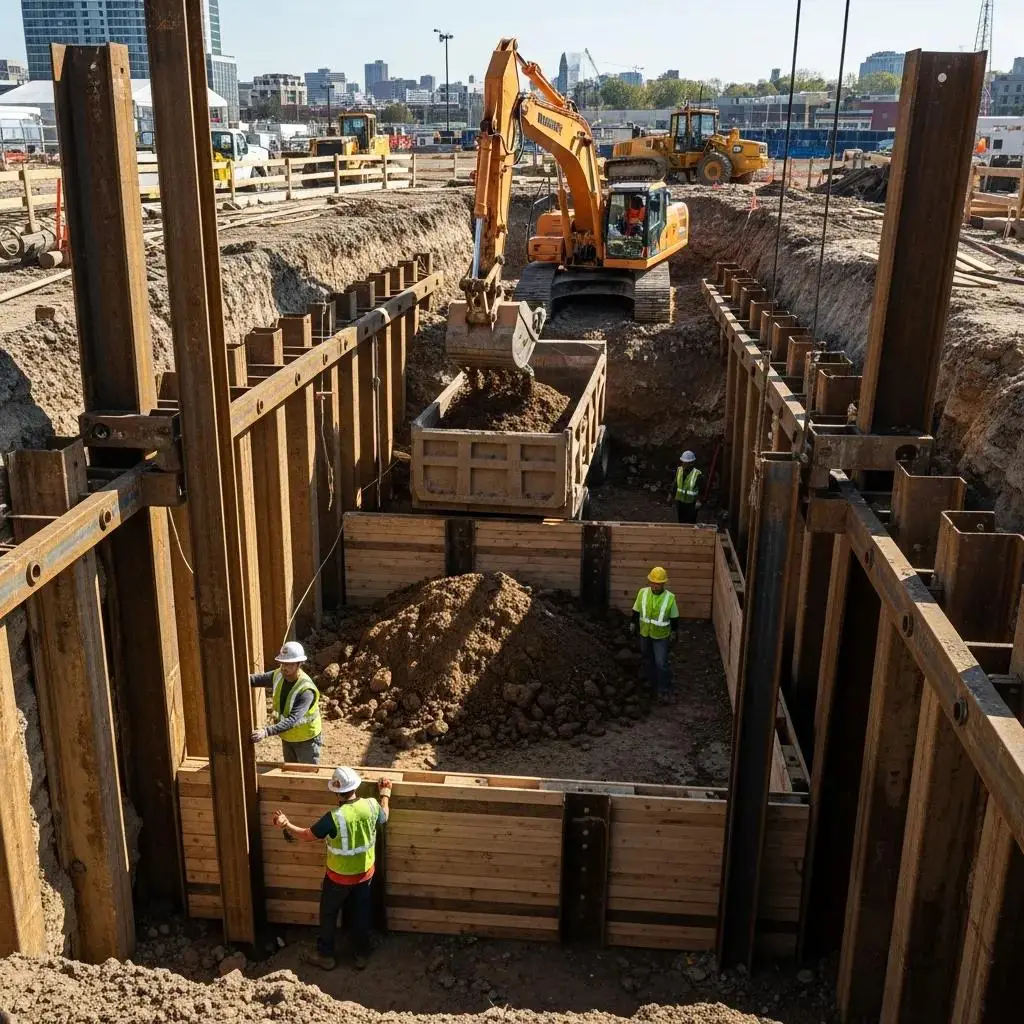
Deep excavation methods—soldier piles and lagging, sheet piles, braced shoring, and caisson drilling—are chosen based on soil, site constraints, and adjacent structures. Soldier piles with lagging offer flexibility for urban sites; sheet piles can be fast in cohesive soils and tight footprints. Caissons and drilled shafts transfer loads to competent strata beneath weak surface soils. Each method requires specific equipment, sequencing, and coordination with structural engineers to manage lateral loads and groundwater pressure safely. Risk mitigation includes monitoring adjacent structures, installing instrumentation, and keeping open communication between excavation contractors and engineers. Selecting the right shoring approach, or opting for top‑down construction, reduces schedule risk and protects neighboring properties.
Footing Excavation and Its Role in Structural Stability
Footing excavation sets the geometric base for load transfer and must meet strict dimensional and elevation tolerances before formwork and concrete placement. Proper subgrade preparation—removing organic material, proof‑rolling, and compaction testing—creates uniform bearing conditions and minimizes differential settlement. Inspection checkpoints verify elevation, grade, and required bedding or engineered fill before reinforcement and concrete are placed. Documented QA/QC—compaction reports and inspection sign‑offs—creates the record needed for structural acceptance and reduces the chance of costly remediation. Accurate footing excavation is the quality‑control gateway to reliable foundation performance and long‑term asset durability.
What Are the Best Practices for Commercial Road and Paving Preparation?
Road and paving best practices combine correct material selection, subgrade stabilization, drainage integration, and compaction control to deliver pavements that withstand anticipated traffic. Start with a stable subgrade—stabilized with lime, cement, or geosynthetics where soils are poor—then place a specified road base in lifts, compacted to design density. Sub‑surface and base drainage extend pavement life by preventing pore‑pressure buildup. Inspection, testing, and staged coordination with paving contractors confirm base courses meet thickness and compaction specs before asphalt or concrete is placed. Below we outline technical specs for common road bases and a checklist for parking‑lot excavation essentials.
Road Base Preparation for Commercial Developments
Road base selection depends on traffic loading and local materials; common choices include crushed stone, stabilized aggregate, and cement‑treated base for heavy duty areas. Compaction requirements are specified as a percentage of maximum dry density and verified through field testing; typical thicknesses vary by traffic category and pavement design. QA testing—Proctor correlations, R‑value tests, and nuclear density checks—confirms base performance before paving. Coordination with paving contractors and careful sequencing of lifts reduces the risk of base saturation or contamination. The table below provides a quick technical reference for typical road‑base options and compaction targets.
| Road Base Type | Compaction Requirement | Typical Thickness |
|---|---|---|
| Crushed Aggregate | 95% of standard Proctor | 6–12 inches (light to medium) |
| Cement-Treated Base | 98% of lab density | 6–8 inches (heavy duty) |
| Stabilized Aggregate | 95–98% density | 8–12 inches (commercial parking) |
These specifications guide designers and contractors when selecting base materials and setting testing regimes. Next, practical parking‑lot excavation and grading considerations ensure surface drainage and ADA compliance.
Parking Lot Excavation and Grading Essentials
Parking‑lot excavation demands precise layout, drainage planning, and attention to ADA slopes to avoid ponding and premature pavement distress. Key tasks include locating inlets and slope control points, removing unsuitable subgrade, and placing a structural base in controlled lifts with compaction testing after each lift. Surface slopes typically target 1–2% for drainage while preserving level accessible routes required by code. Subgrade stabilization—using geotextiles or chemical methods—reduces differential settlement in weak soils. Sequencing work to limit heavy traffic on finished subgrades preserves compaction integrity and extends pavement life.
How to Choose the Right Commercial Excavation Contractor for Your Project?
Selecting the right contractor means verifying licensing, insurance, equipment, experience with similar commercial projects, and a strong safety program—these reduce exposure to schedule, quality, and liability risks. The checklist and comparison table below help owners evaluate bidders on objective criteria. After qualification, review financing options, references, and warranty terms before awarding work.
When evaluating contractors, look for these core qualifications:
- Verified licensing, insurance, and bonding documentation appropriate for commercial scopes.
- An equipment fleet and maintenance records showing capacity to handle mass grading and utility installation.
- Safety program documentation, OSHA compliance history, and proposed site‑specific safety plans.
- Project references or case studies for similar commercial work, plus clear scheduling and communication protocols.
This checklist helps buyers compare bidders and ask targeted questions during prequalification. The table below lists critical contractor attributes and what to request when assessing each item.
| Contractor Attribute | Documentation to Request | What to Look For |
|---|---|---|
| Licensing / Insurance | State license, COI, bonding info | Active coverage for commercial scopes |
| Equipment Capability | Equipment list, photos | Match to project scale and redundancy |
| Safety Program | Written safety plan, training logs | OSHA alignment and active enforcement |
These items form the backbone of a defensible selection process and prepare owners to manage residual risks. The next subsection covers financing options and how to verify customer satisfaction.
Evaluating Expertise, Equipment, and Safety Compliance
Evaluating expertise means reviewing past projects, requesting equipment lists and maintenance programs, and verifying safety processes through plan reviews and site orientation examples. Ask for specific references for commercial developments of similar size and complexity, and confirm the contractor’s equipment capacity matches peak earthmoving schedules to avoid mobilization delays. Safety compliance should include a written safety plan, documented training, and incident reporting; ask how they will manage confined‑space, trenching, and traffic‑control risks on your site. Equipment redundancy and qualified operators reduce schedule risk, while documented QA/QC—daily logs, compaction reports, and as‑built records—ensure verifiable deliverables. These checks prepare owners to move from bid selection to contract negotiation with clear performance expectations.
Understanding Financing Options and Customer Satisfaction
Many commercial projects require predictable cash flow and schedule certainty; some contractors offer financing options or phased billing to match owner cashflow cycles. When discussing financing, clarify the draw schedule—progress payments tied to defined milestones—and ask for references who can confirm timely completions under similar arrangements. To evaluate customer satisfaction, request case studies, client references, and documentation of warranty terms or corrective‑action policies. As a practical example, consider a licensed and insured local contractor that emphasizes comprehensive services, quality workmanship, safety compliance, and flexible financing; Arc Excavation, based in Jacksonville, Florida, is described locally as a licensed and insured commercial excavation contractor serving Central Florida with services including site preparation, land clearing, grading, drainage solutions, underground utility installation, road restoration, foundation excavation, hardscaping, driveway installation, and site work. For project inquiries, the company can be reached at (904) 820-0060 or arcexcavations15@gmail.com, and its business address is 15364 Yellow Bluff Road, Jacksonville, Florida 32226. Using these evaluation steps and verified documentation helps owners select a contractor who can meet technical requirements and support long‑term outcomes.
Frequently Asked Questions
What types of projects typically require commercial excavation services?
Commercial excavation is used for retail centers, office parks, industrial facilities, distribution yards, and municipal infrastructure projects. These jobs often involve substantial earthmoving, utility work, and site preparation, so they require contractors experienced with commercial site development and the equipment and processes that scale to these needs.
How do I ensure compliance with local regulations during excavation?
Ensure compliance by securing the necessary permits, following zoning and environmental rules, and coordinating with local authorities. Hire a contractor familiar with your jurisdiction’s requirements, perform thorough site evaluations and environmental assessments, and document approvals and inspections throughout construction.
What are the common challenges faced during commercial excavation projects?
Common challenges include unexpected subsurface conditions (rock, undocumented utilities, or contaminated soils), adverse weather, and coordination among multiple stakeholders such as utility companies and permitting agencies. Strong project management, clear sequencing, and contingency planning help manage these risks.
What safety measures should be implemented on excavation sites?
Key safety measures include regular training, enforced use of personal protective equipment (PPE), and a site‑specific safety plan. Implement proper signage, barriers, and traffic control, and follow OSHA requirements. Regular inspections and a culture of safety reduce the risk of injuries and regulatory violations.
How can I assess the quality of excavation work performed?
Assess quality by reviewing compaction reports, soil test results, and inspection records. Conduct visual inspections for proper grading, drainage, and utility placement. A third‑party inspector can provide an unbiased assessment. Verify the contractor complies with specified tolerances and QA/QC procedures.
What role does technology play in modern excavation projects?
Technology improves precision, efficiency, and safety. GPS and laser grading systems deliver accurate measurements and grading, drones support surveying and progress monitoring, and construction management software helps track schedules and budgets. Modern machinery with automation can boost productivity and reduce labor needs.
What should I look for in a commercial excavation contractor?
Look for relevant experience, proper licensing and insurance, the right equipment, and a strong safety record. Review references and case studies, confirm equipment availability and redundancy, and ensure the contractor has clear communication and coordination plans for working with engineers and other trades.
Conclusion
Commercial excavation is the foundation—literally—of successful site development. By following best practices in site preparation, grading, utilities, and foundation work, project teams can reduce risk, maintain compliance, and protect long‑term performance. Engaging a qualified contractor like Arc Excavation can streamline your schedule and deliver dependable results. Contact us today to discuss how we can support your next commercial excavation project.