
What Are Effective Commercial Drainage Solutions in Florida
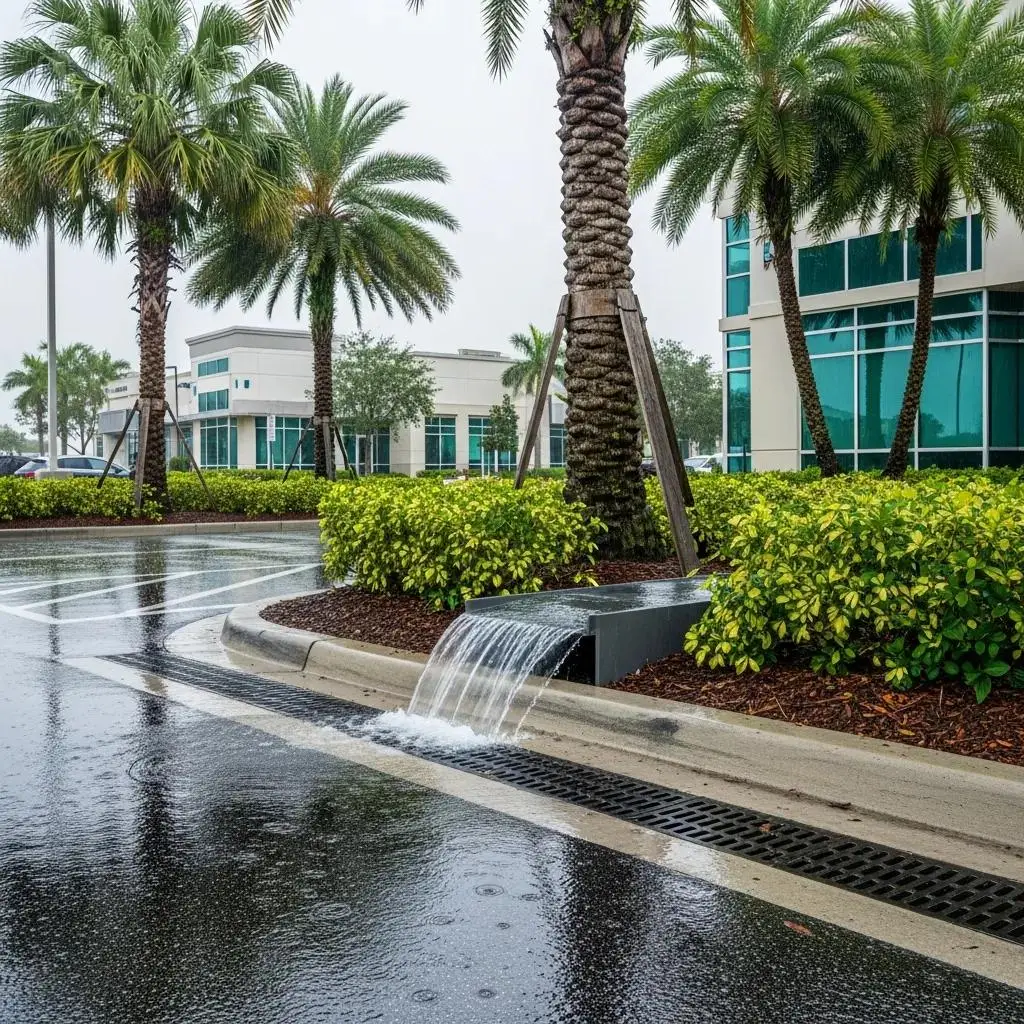
Effective Florida Commercial Drainage Systems to Protect Properties
Commercial drainage solutions are engineered systems—pipes, trenches, basins, ponds and surface works—built to collect, move, store, and treat stormwater on commercial properties so operations and assets stay protected. In Florida, designs must handle frequent heavy rain, high groundwater, and large areas of impervious surface to prevent foundation damage, erosion, and business interruptions. This guide lays out common drainage challenges for commercial sites in Florida, compares proven systems like French drains, trench drains and retention ponds, and explains how permitting and maintenance affect performance and lifecycle cost. You’ll find step-by-step installation and maintenance workflows, practical prevention measures (grading, permeable pavement), and guidance for evaluating performance and long‑term costs for commercial properties in Jacksonville and nearby areas.
Common Commercial Drainage Challenges in Florida
Florida commercial sites face a predictable set of drainage issues that increase design complexity and long‑term cost. Short, intense convective storms create large runoff volumes that can overwhelm undersized conveyance; flat terrain and high groundwater limit infiltration and cause persistent ponding near foundations. Large impervious areas—parking lots, roofs—raise peak flows and pollutant loads, while coastal and tidal influences complicate outfall design and elevation control. These factors require integrated systems that balance storage, conveyance capacity, and water‑quality controls to protect assets and keep businesses running.
Typical drainage challenges in Florida include:
- Short‑duration, high‑intensity storms that produce sharp peak flows.
- Poorly draining soils and elevated groundwater that limit infiltration and raise hydrostatic pressure.
- Large expanses of impervious surface that accelerate runoff and concentrate contaminants.
- Permitting and outfall constraints near coasts and existing storm networks.
Recognizing these constraints helps guide the right choices for system size, type, and maintenance frequency so solutions meet both site needs and regulatory requirements.
How Florida’s Climate Shapes Drainage Needs
Florida’s long wet season, frequent thunderstorms, and occasional tropical systems require larger conveyance capacities and resilient outfalls. High‑intensity, short storms mean designers often plan for higher return‑period events compared with temperate climates. Elevated groundwater and seasonal fluctuations also affect subsurface systems—French drains, for example, must be sized to handle both surface runoff and shallow groundwater while avoiding buoyancy issues for buried structures. Local guidance and event‑based hydrologic modeling are commonly used to set peak flows and detention needs for commercial developments.
Because of these climate drivers, successful systems usually combine surface and subsurface measures—detention basins paired with trench drains, for example—so they perform during typical storms and extreme events. That integration also informs permitting and long‑term maintenance expectations, which we cover next.
Risks of Inadequate Drainage for Commercial Properties
Poor drainage creates clear risks: structural damage, rising maintenance costs, and downtime that hits revenue and safety. Ponding and higher hydrostatic pressure can undermine foundations, crack pavement, and speed erosion at cut‑and‑fill slopes—often triggering costly repairs and tenant disruption. Standing water also increases slip hazards, attracts pests, and can lead to fines when stormwater controls fail to meet local standards. Repeated flooding raises insurance claims, premiums, and can reduce property value if problems persist.
Reducing these risks starts with early planning: proper grading, right‑sized conveyance and storage, and scheduled maintenance to prevent sediment buildup and clogging. Proactive maintenance planning cuts emergency repairs and keeps your site operational.
Most Effective Commercial Drainage Systems for Florida
Commercial drainage solutions in Florida typically combine surface conveyance, subsurface collection, and centralized storage to manage heavy volumes and meet local regulations. Common, effective components include French drains for foundation and groundwater control, trench drains for linear surface flow in parking and loading areas, catch basins and underground piping for collection and conveyance, and detention/retention ponds for site‑scale flow control and water quality. Each option differs in installation complexity, capacity, and maintenance needs, which determines the best fit for retail centers, industrial parks, or large developments.
The table below summarizes typical use, capacity, installation complexity, cost range, and common commercial applications for key systems.
| System Type | Typical Capacity/Scale | Installation Complexity | Typical Cost Range | Common Commercial Applications |
|---|---|---|---|---|
| French Drain | Manages groundwater and shallow subsurface flow; localized capacity | Moderate — trenching, filter fabric, gravel, perforated pipe | Moderate | Perimeter foundation protection, landscaped buffers |
| Trench Drain | High linear surface flow control for concentrated runoff | Moderate–high — precise grading and load‑rated grates | Moderate–high | Parking lots, loading docks, driveways |
| Catch Basin & Underground Piping | Point collection and conveyance to outfall or pond | Moderate — excavation, bedding, pipe installation | Moderate | Storm sewer tie‑ins, parking field drainage |
| Retention/Detention Pond | Large‑volume storage and water‑quality treatment | High — earthwork, liners, outlet structures | High | Large commercial developments, shopping centers, industrial parks |
This comparison highlights trade‑offs so you can match a solution to site area, impervious coverage, and available maintenance resources. Next we’ll look at each system in practical detail and outline realistic maintenance expectations.
Many commercial owners choose to work with experienced local contractors for system sizing and installation—especially where multiple components (trench drains, catch basins, ponds) are integrated. ARC Excavation Inc., a Jacksonville contractor specializing in excavation, drainage, and hardscaping services, has hands‑on experience installing trench and French drains and coordinating pond construction for commercial sites. For a site assessment and a cost‑focused, complete solution that addresses technical challenges safely and efficiently, requesting a local quote clarifies scope and budget.
How French Drains Protect Foundations and Landscapes
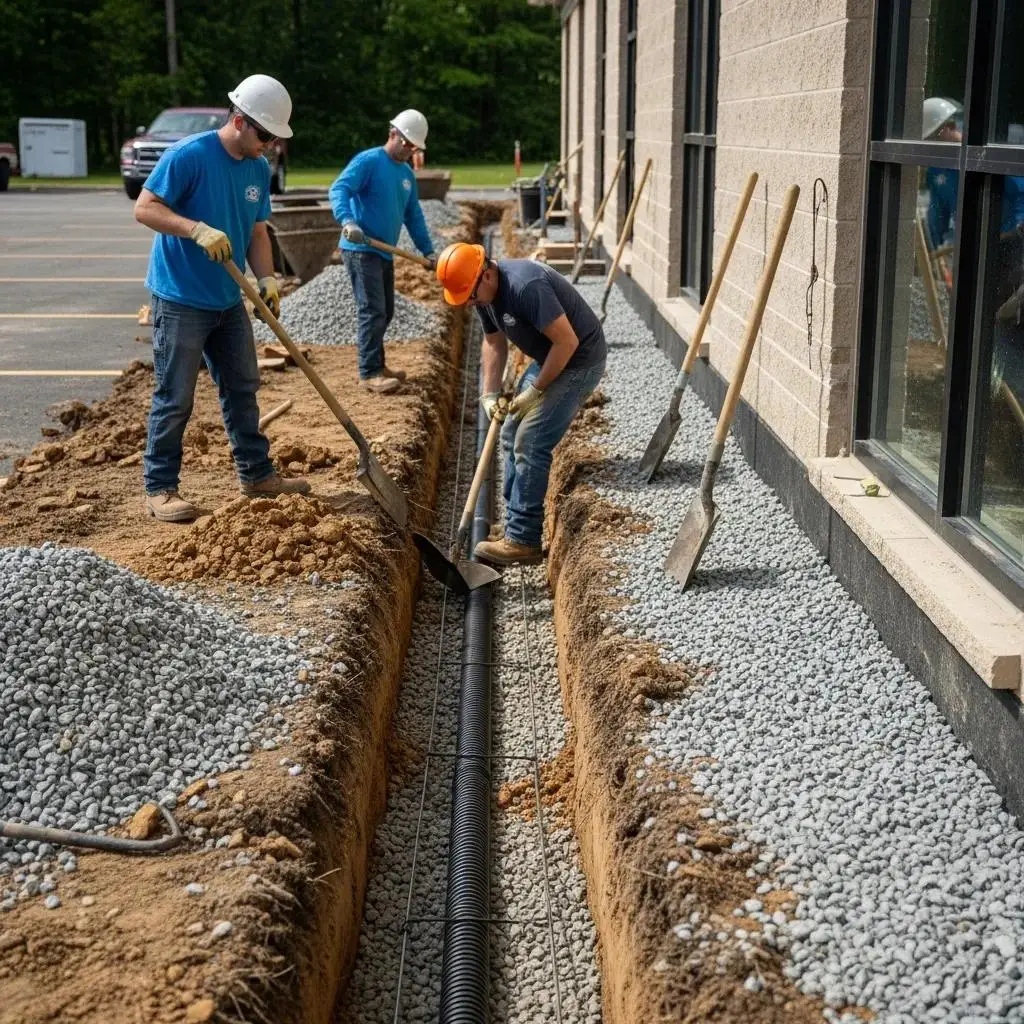
A French drain is a subsurface collection system that intercepts groundwater and reroutes it away from foundations and saturated landscape areas through perforated pipe set in crushed stone. It reduces hydrostatic pressure against foundations and lowers the local water table next to structures, helping to prevent seepage into crawlspaces and landscaped beds. On commercial projects, these systems are typically deeper, use heavier filter fabric, and include inspection access to handle higher groundwater and sediment loads. Good design checks depth relative to footings, ensures slope for gravity drainage, and provides a suitable outfall so you’re not simply moving water to another problem area.
Regular inspection and flushing of access points keeps performance reliable. Combine French drains with improved surface grading to reduce sediment entry and extend system life. That helps you decide whether a French drain alone is sufficient or if it should be part of broader stormwater management.
Why Trench Drains Work Well for Parking Lots and Industrial Areas

Trench drains give fast linear conveyance, catching sheet flow at curbs, entrances, and loading lanes to prevent pavement ponding where vehicles and people circulate. They use load‑rated grates and reinforced channels to withstand traffic; materials range from polymer concrete to precast concrete depending on design life and load. You place them at low points and transitions where flows concentrate, then connect them to underground piping or catch basins that lead to detention systems or outfalls.
Design must include accurate capacity calculations, proper grate selection to limit debris entry, and attention to ADA and vehicular safety near walkways. When specified and installed correctly, trench drains limit pavement damage and deliver dependable conveyance in high‑runoff commercial settings.
Role of Catch Basins and Stormwater Ponds in Commercial Drainage
Catch basins collect runoff and trap coarse sediment before water enters pipes that route it to an outfall or detention/retention basin. They protect downstream pipes from blockage and are essential across large parking fields and roof drain networks. Stormwater ponds—detention (temporary storage) or retention (permanent pool for treatment/infiltration)—control peak flows, settle sediment, remove pollutants, and often satisfy local water‑quality requirements for commercial developments.
Pond design balances required volume, available footprint, and drawdown time to meet permits; maintenance generally includes sediment removal and vegetation management to preserve capacity and treatment performance. The right mix of basins and ponds ensures hydraulic control and compliance for commercial properties.
How Florida Stormwater Regulations Influence Drainage Design
Florida’s stormwater regulations require commercial projects to meet state and local rules for flood control, pollutant reduction, and long‑term maintenance, which directly affects system sizing and documentation. Typical requirements include limiting stormwater volumes or peak discharges, demonstrating accepted water‑quality practices, and providing maintenance plans or covenants that ensure continued function. Local jurisdictions often add design details—drawdown periods, buffer zones, or native‑plant criteria—that determine whether a detention basin, infiltration system, or engineered wetland is appropriate.
Practical compliance steps include early engagement with permitting authorities, using hydrologic and hydraulic modeling to support designs, and preparing clear operation and maintenance plans inspectors can approve. Meeting these requirements lowers the risk of fines and construction delays and is essential for responsible site design.
Key Stormwater Requirements for Florida Commercial Properties
Common expectations are controlling peak discharge to pre‑development levels for selected design storms, providing water‑quality treatment for prescribed runoff volumes, and documenting long‑term maintenance responsibilities. Many municipalities require engineered calculations, site plans showing easements and outfalls, and post‑construction inspection schedules. Coastal and tidal sites may add rules on outfall elevations and considerations for tidal backflow or sea‑level rise, which can require pumps or one‑way valves for low outfalls.
Permitting also usually mandates construction‑phase erosion and sediment controls during earthwork. Preparing thorough permit packages and maintenance agreements upfront helps avoid approval delays.
How ARC Excavation Keeps Projects Compliant
ARC Excavation Inc. uses local Jacksonville experience to shape drainage designs that meet Florida and municipal stormwater expectations, supporting owners through permitting and installation. Their services include site assessment, coordination with engineers and permitting authorities, and installation practices that balance safety and efficiency. ARC focuses on complete, cost‑effective solutions that resolve technical constraints—high groundwater, limited outfalls—while maintaining strong excavation and site‑management practices. This local know‑how helps speed approvals and reduces the need for costly redesigns or compliance rework.
ARC pairs field experience with documentation‑ready deliverables to keep project timelines predictable and help owners meet regulatory obligations without surprises.
Process for Installing and Maintaining Commercial Drainage Systems in Florida
Commercial drainage projects move through clear phases: assessment, design and engineering, permitting, excavation and installation, testing and handover, and ongoing maintenance. Each phase has specific deliverables—survey and soil data during assessment; hydrologic/hydraulic calculations during design; erosion‑control and permit applications during permitting; controlled excavation and QA in installation; and scheduled inspections and sediment management during maintenance. Clear roles—owner, engineer, contractor, permitting authority—ensure decisions about sizing, materials, and outfalls are coordinated and recorded.
The project‑phase table below maps phases to typical timeframes, responsibilities, and outcomes so owners can plan budget and schedule.
| Phase | Typical Timeframe | Primary Responsibility | Expected Outcome |
|---|---|---|---|
| Assessment | 1–3 weeks | Owner/Engineer | Site survey, soil data, baseline constraints |
| Design & Engineering | 2–6 weeks | Engineer/Designer | H&H calculations, system selection, plans |
| Permitting | 4–12 weeks | Owner/Contractor | Approved permits, erosion‑control plan |
| Excavation & Installation | 1–8 weeks | Contractor | Installed systems, as‑built documentation |
| Testing & Handover | 1–2 weeks | Contractor/Engineer | System validation, punch list |
| Maintenance | Ongoing | Owner/Service Provider | Scheduled inspections, sediment removal |
This phased approach makes decision points clear and helps commercial stakeholders set realistic expectations for schedule and cost.
Quick checklist (HowTo):
- Conduct a site assessment—collect topography, soil, and drainage constraints.
- Develop designs and H&H calculations—size systems for local design storms.
- Submit permits—secure approvals before construction.
- Excavate and install—follow best practices for bedding and compaction.
- Test and commission—then set a routine maintenance schedule.
Following these steps reduces risk and helps ensure systems perform as intended. If you need a site evaluation and a written quote to turn design into a budget and schedule, ARC Excavation Inc. offers assessment, permitting assistance, and installation for commercial drainage projects in Jacksonville and nearby communities.
Steps in Commercial Drainage Design and Installation
Design and installation start with data collection—topography, infiltration rates, and utilities—then move to runoff and storage calculations for selected design storms. Designers pick system types (trench drains, French drains, ponds), set grades, pipe sizes, and outlet elevations that meet performance and permit needs. Procurement emphasizes load‑rated grates, corrosion‑resistant pipe, and maintenance access. Installation calls for controlled excavation, proper bedding and compaction, and accurate as‑built records. Final testing confirms conveyance, outlet operation, and that water‑quality controls meet specifications.
Coordination at milestones—90% design review, pre‑construction meeting, post‑installation inspection—reduces scope creep and keeps the project aligned with operational needs and budget.
How Routine Maintenance Prevents Drainage Failures
Regular maintenance preserves capacity and prevents failures caused by sediment, vegetation, and debris that block grates and pipes. A practical checklist includes clearing grates and catch basins, vacuuming or removing sump sediment, pressure‑jetting lines when needed, inspecting and repairing pond banks, and replacing damaged grates or covers. Inspection frequency commonly ranges from quarterly to annually based on site use and local sediment loads, with extra checks after major storms.
Preventive maintenance reduces pavement undermining, foundation seepage, and compliance risks. A documented maintenance contract with scheduled deliverables typically lowers emergency repair costs and downtime.
Preventing Flooding and Erosion with Drainage Solutions
Stopping flooding and erosion requires combining grading, engineered conveyance, and landscape‑based controls to manage flow paths and slow velocities. Effective plans prioritize positive grading away from buildings, add detention or retention to attenuate peaks, and protect outfalls and slopes with riprap or vegetative reinforcement to dissipate energy. In tight sites, underground storage and high‑capacity piping may be preferred; on larger footprints, ponds and vegetated swales provide both control and water‑quality benefits.
The table below compares common prevention strategies by effectiveness, cost, and typical suitability to help owners prioritize investments.
| Strategy | Effectiveness | Typical Cost | Suitability |
|---|---|---|---|
| Site grading & swales | High — directs flow away from structures | Low–Moderate | Most sites; essential first step |
| Retention/Detention ponds | High — peak control and treatment | Moderate–High | Large developments and campuses |
| Permeable pavement | Moderate — reduces runoff volume | Moderate–High | Low‑traffic lots, plazas |
| Vegetative buffers & biofiltration | Moderate — pollutant reduction | Low–Moderate | Where land area allows |
Combining several of these measures typically gives the best balance between upfront cost and long‑term protection.
Practical prevention tactics for Florida commercial sites include:
- Prioritizing positive grading and well‑shaped swales to move water away from buildings.
- Sizing retention/detention systems for local storm frequencies to reduce peak discharge.
- Protecting outfalls with riprap, vegetative mats, or engineered transitions to prevent erosion.
Layering hardscape conveyance with vegetated treatment reduces erosion and improves resilience in extreme storms.
High‑Impact Flood Prevention Strategies for Florida Commercial Sites
Start with grading to force water away from buildings and critical infrastructure, then add localized linear conveyance—trench drains—where flows concentrate. For larger properties, detention or retention basins sized for design storms offer peak control and pollutant removal; include forebays and sediment traps to simplify maintenance. Permeable pavements can lower effective imperviousness but need proper subbase and upkeep to sustain infiltration. Erosion protection at outfalls—riprap, energy dissipaters, and vegetated buffers—prevents downstream damage and stabilizes the site.
Prioritize measures that prevent structural damage first—grading and conveyance—then layer in water‑quality and infiltration strategies where land and budget allow.
How Grading and Excavation Improve Drainage Performance
Professional grading and excavation set flow paths, establish design slopes, and create subgrades for basins, swales, and pipe bedding—basically everything drainage depends on. Small, consistent slopes encourage sheet flow to collection points and reduce ponding; correct compaction and subbase work prevent settlement that changes grades over time. Excavation also creates room for underground storage and provides access for inspection and cleaning, supporting long‑term maintenance.
Well‑executed grading cuts peak runoff entering systems, which can reduce pipe sizes and lower sedimentation rates—improving performance and decreasing maintenance needs over the system’s life.
Why Choose ARC Excavation Inc. for Commercial Drainage in Florida?
ARC Excavation Inc. is a Jacksonville‑based contractor specializing in excavation, drainage, and hardscaping for commercial clients who need practical, site‑specific solutions. The company delivers complete, cost‑effective approaches that overcome technical challenges while keeping safety and operational efficiency front and center during construction. ARC installs and repairs trench drains and French drains, coordinates pond construction, and manages underground conveyance—backed by local experience with Jacksonville permitting and construction conditions. For owners who want a reliable partner to turn drainage design into a durable, maintainable system, ARC provides drainage solutions you can trust.
ARC’s value is practical problem‑solving, safety‑focused operations, and delivering solutions that fit project goals and budgets. Property owners can request a project quote or site evaluation to explore options tailored to site constraints and compliance needs.
ARC Excavation’s Expertise for Commercial Drainage Projects
ARC Excavation brings field experience in excavation, drainage installation, and hardscaping that matters for commercial sites in Jacksonville and surrounding areas. Their work includes trench and French drain installation, pond coordination, and excavation management with a focus on safety and efficiency. ARC aims to provide cost‑effective, complete solutions for common commercial challenges—high groundwater, limited outfalls, and heavy traffic loads—so owners can move from assessment to installation with a single contractor who coordinates with designers and authorities.
These capabilities make ARC a practical choice for commercial clients seeking a local contractor experienced in the realities of Florida drainage projects.
Commercial Drainage Case Study Elements That Show Results
Strong case studies for drainage work outline the initial challenge, the engineered solution, installation approach, and measurable outcomes—fewer flooding incidents, permit acceptance, restored operations. Useful entries include a site summary, constraints discovered during assessment, the chosen system(s) and why, installation highlights (excavation strategy, materials, sequencing), and outcomes such as reduced ponding or compliance milestones. Photos, timelines, and before‑and‑after performance indicators strengthen the story and demonstrate return on investment.
Use these elements to evaluate a contractor’s past performance and set realistic expectations for schedule, cost, and maintenance when soliciting proposals.
To request an on‑site evaluation and written quote for your property, contact ARC Excavation Inc. at (904) 820-0060 to schedule an assessment and discuss cost‑effective drainage options.
Frequently Asked Questions
What factors should be considered when selecting a commercial drainage system in Florida?
Key considerations include site topography, soil type, and impervious coverage—these affect runoff and infiltration rates. Also factor in expected stormwater volumes, local climate patterns, and regulatory requirements. Evaluate long‑term maintenance needs and lifecycle cost for each system, and consult local experts to tailor solutions to your site constraints.
How often should commercial drainage systems be inspected and maintained?
Inspect systems at least once or twice a year, and more often after major storm events. Regular maintenance—clearing grates, cleaning catch basins, removing sediment from ponds, and flushing pipes—keeps capacity from declining and prevents emergencies. A documented maintenance plan helps ensure compliance and extends system life.
What are the benefits of using permeable pavement in commercial drainage solutions?
Permeable pavement reduces runoff by allowing infiltration, which helps mitigate flooding and recharge groundwater while filtering pollutants. It can improve aesthetics and functionality for pedestrian areas, but it requires a proper subbase and ongoing maintenance to preserve infiltration rates—so it’s best in low‑traffic or well‑maintained areas.
How do local regulations impact the design of commercial drainage systems?
Local rules shape component sizing, allowable discharge rates, and required treatment measures. Regulations often require engineered calculations, site plans showing easements and outfalls, and maintenance commitments. Engaging permitting authorities early in the design process helps ensure proposed solutions meet criteria and speeds approvals.
What role do vegetation and landscaping play in drainage management?
Vegetation helps absorb water, reduce runoff, and stabilize soils. Root systems improve infiltration, and vegetative buffers or biofiltration areas slow flows and remove pollutants before water reaches drainage structures. Using native plants lowers maintenance and supports local ecology—making landscaping an effective part of a drainage strategy.
What are common mistakes to avoid when installing drainage systems?
Common errors include skipping a thorough site assessment, undersizing components, and ignoring local regulations. Failing to provide maintenance access or to account for soil conditions and topography can lead to system failure. Following best practices for bedding, compaction, and inspection access—and hiring experienced contractors—reduces these risks.
Conclusion
Effective commercial drainage in Florida protects buildings, reduces erosion, and helps you stay compliant. By understanding climate‑driven challenges and choosing the right mix of grading, conveyance, and storage—and by planning for maintenance—property owners can safeguard investments and minimize downtime. Working with experienced local contractors like ARC Excavation Inc. streamlines permitting and installation and delivers practical, maintainable solutions. For a comprehensive assessment and a quote for your drainage project, reach out to our team today.